Birdwatching in Burigi-Chato National Park works across open water, papyrus swamp, wooded savannah, riverine forest and floodplain, producing a list running into the hundreds of species with African fish eagles at unusually high density and papyrus specialists in the lake inlets. Boat and canoe trips reach the best habitat. Burigi-Chato covers 4,707 square kilometres of northwestern Tanzania beside Lake Victoria, and birds are the strongest wildlife draw here.
This is the one activity where the park competes properly with better known reserves.
Why This Is the Best Birding Safari in the Lake Zone
The case for a birdwatching safari here rests on habitat variety packed into short distances rather than on any single rarity.
Five distinct bird communities sit within a few kilometres of each other. Open water and shoreline. Papyrus and reed swamp. Wooded savannah under open deciduous canopy. Riverine forest along the watercourses, with surviving fragments of Guinea-Congo forest in the steeper gullies. And floodplain grassland that floods and drains on an annual cycle.
Each holds species the others do not. Working three of them in a morning is realistic here in a way it is not in a single-habitat park.
Position helps too. Sitting beside the largest lake in Africa puts the park in a major flyway, so waterbird populations move through and Eurasian migrants arrive from around November.
Plan a birding day as boat first, then woodland, then floodplain edge at last light. That sequence takes you through three communities while the light is working in your favour at each.
Waterbird Watching on Lake Burigi
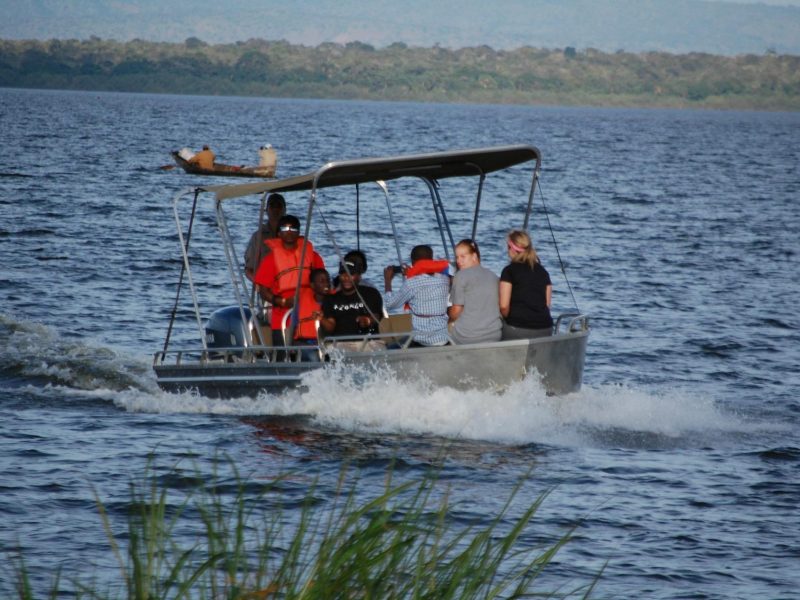
The lake is where a birding trip should start, and the boat is the tool.
African fish eagles occur at unusually high density along this shoreline, perching on dead limbs above the water and calling. Their call is the defining sound of any trip here. Saddle-billed stork work the shallows, and herons, egrets and pelicans occupy the water margins alongside several kingfisher species.
Wattled crane, wattled lapwing and Senegal lapwing are recorded around the wet ground. Cattle egret follow the grazing herds. Village weaver colonies hang over the watercourses, and white-browed coucal works the swamp margins.
Lake Burigi runs roughly 30 kilometres long and about 4 kilometres wide with a scatter of islands and many inlets, so a single boat outing can work several very different stretches of shoreline.
TANAPA charges a boating safari fee here, and canoeing is offered separately with a three-hour cap per session.
Papyrus Specialist Birding in the Swamp Inlets
The swampy bays branching off the lake hold the birds that dedicated birders travel for.
Papyrus is a specialised habitat with its own restricted-range community, and the papyrus gonolek is the species associated with these reed beds. Working a papyrus edge means coming in slowly and quietly from the water, listening as much as looking, since much of what lives inside a reed bed is heard long before it is seen.
A canoe beats a motorised boat here. Silence along a reed line is worth more than the range an outboard gives you, and it lets you hold position at the margin without pushing birds back into cover.
The same inlets hold sitatunga, the semi-aquatic antelope that feeds at the papyrus margins at dawn and dusk, so a birding session here often doubles as a mammal one.
Papyrus is why this park matters to birders. Very few places in Tanzania give you protected access to extensive reed beds with a boat and a ranger.
The Shoebill Question on a Burigi-Chato Birding Trip
Ask about shoebill and you will get an optimistic answer from many websites. Here is the careful version.
Conservation assessments of this area have flagged that the lakeside swamps may hold breeding Balaeniceps rex, and the habitat is right for it: extensive undisturbed papyrus with shallow water. Park literature raises the possibility. Recommendations have been made to bring a larger share of Lake Burigi and its lakeside swamps under protection partly for this reason.
Confirmed sightings here, though, are scarce, and the area is barely surveyed. This is not Uganda’s Mabamba Bay, where boat guides find known individuals daily.
If shoebill is your specific target, build the trip around a site with a documented population and treat Burigi-Chato as a genuine possibility rather than a plan. Any operator guaranteeing one is overselling.
Woodland Birding Tours in the Miombo
The wooded savannah covering most of the park has its own community and its own rhythm.
Miombo birding is slow and often quiet for long stretches, then suddenly busy when you hit a mixed feeding party moving through the canopy. That pattern is normal and worth waiting for rather than driving past.
Red-necked francolin occurs on the open ground, with guineafowl, hornbills and marabou stork recorded through the park. African grey parrots, introduced into the wider Lake Victoria region, occur in parts of the forested ground.
The woodland here is described as miombo locally, with Combretum and Terminalia dominant and Brachystegia on the higher ground, including Brachystegia spiciformis at the northern edge of its range. Protea and Combretum occupy the drier western ridges.
Bring binoculars with good low-light performance. Canopy shade costs you more light than you expect.
Forest Birding in the Valley Gullies
The most interesting birding ground is the hardest to reach.
In the steeper valleys and gullies there are surviving patches of Guinea-Congo forest, remnants of a forest type that once extended much further east, with relict sclerophyll forest in sheltered pockets. These fragments hold forest species absent from the woodland a few hundred metres above.
Riverine forest along the watercourses is easier to work and holds kingfishers, herons and a range of woodland-edge birds, with the corridor structure concentrating movement along it.
Reaching the tightest gullies usually means walking, since vehicle tracks rarely drop that far. Walking safaris with an armed ranger are split into short walks of one to four hours and long walks above four hours.
Raptor Watching on the Escarpments
The ridge and crag country adds a set of species the wetlands do not.
Cliff faces and rocky outcrops give nesting and perching sites, and thermals rising off warmed rock through the morning give soaring birds their lift. Augur buzzard, snake eagles and vultures work these updrafts. Verreaux’s eagle is associated with crag country across the region wherever hyrax are present, and rock hyrax colonise the boulder piles here.
Martial eagle, the largest eagle in Africa, is recorded in the park. Cliff chat, mocking cliff chat and rock martin are the smaller rock-associated species to scan for.
Mid-morning is the time, once the sun has been on the rock faces for an hour or two and the thermals have built.
Best Season for a Birdwatching Safari in Burigi-Chato
Birding runs against the general pattern here, which is worth knowing when you book.
November to March: The strongest window. Eurasian migrants arrive from around November and stay through the northern winter, floodplains fill and pull in waders and storks, and resident species come into breeding plumage.
January and February: A drier interval between the two rainfall peaks with migrants still present and tracks mostly usable. The best combination of access and bird numbers.
June to September: Dry season. Waterbird concentrations on Lake Burigi remain strong as other water dries up, and access is at its most reliable, though migrants have gone.
March to May: Heaviest rain and highest water. Birding is excellent and access is the constraint, with unsurfaced tracks limiting where you can go.
If you can only travel once and birds are the priority, aim for December through February.
How Many Species and What to Expect on a Birding Trip
Figures quoted for this park range from around 300 to over 400 species, and the higher end is plausible given the habitat mix. The park has not been comprehensively surveyed, so treat any precise number with caution rather than as established fact.
What a two or three day trip realistically produces is a strong waterbird list, good raptor coverage, a scatter of woodland species and the possibility of a papyrus specialist. A serious birder working all the habitats with a good guide will do considerably better than a general visitor adding birds to a game drive.
Bring your own field guide covering East Africa. The park has no visitor centre stocking one.
A park guide is charged per group per day rather than per person, and a birding-specific guide, where one is available, makes a substantial difference to what you actually identify.
Frequently Asked Questions About Birdwatching in Burigi-Chato
What does a birding trip cost?
The conservation fee is currently US$30 per person per day for non-East African adults aged sixteen and above and US$10 for children aged five to fifteen, with US$15 and US$5 for expatriates and Tanzanian residents and TZS 5,000 and TZS 2,000 for East African Community citizens. The boat safari that reaches the best habitat adds US$20 per person and canoeing US$10 for up to three hours. Walking safaris are US$20 per adult for short walks and US$25 for long ones. A park guide is US$20 per group per day. Add 18 percent VAT to all TANAPA charges.
How many bird species are there?
Quoted figures range from around 300 to over 400, and the higher end is credible given the habitat mix of open water, papyrus swamp, wooded savannah, riverine forest and floodplain. The park has not been comprehensively surveyed since gazettement in 2019, so no precise number should be treated as established. What is clear is that birding is the strongest wildlife draw here, particularly for waterbirds, raptors and papyrus specialists.
Can I see shoebill here?
Possibly, but treat it as a long shot. Conservation assessments have flagged that the lakeside swamps may hold breeding shoebill and the papyrus habitat suits the species, but confirmed sightings are scarce and the area is barely surveyed. If shoebill is your specific goal, build your trip around a site with a documented population and regard any Burigi-Chato sighting as an unexpected bonus. Be sceptical of anyone selling a guaranteed shoebill trip here.
When is the best time for birding?
November through March, when Eurasian migrants are present, floodplains hold water and residents are in breeding plumage. December to February is the sweet spot, since it falls in the drier interval between the two rainfall peaks so tracks remain mostly usable while the birds are still there. The June to September dry season still gives strong waterbird concentrations on Lake Burigi and the most reliable access, but the migrants have gone.
Is a boat necessary for good birding?
For the best of it, yes. Papyrus specialists live in the swamp inlets, which no vehicle track reaches and which cannot be walked into, since papyrus grows on floating mats over water holding hippo and crocodile. The high-density fish eagle stretches are along the shoreline. A canoe is better than a motorised boat for shy reed-bed species, since silence matters more than range along a papyrus margin, though it is capped at three hours per session here.
Do I need a specialist bird guide?
It helps considerably, particularly for the woodland and papyrus species where much of what you detect is heard rather than seen. A general park guide, charged at US$20 per group per day, will get you to the right habitat and handle the boat and safety side. Arrange a birding-specific guide in advance through your operator if you want serious identification support, since the park has no visitor centre and none will be waiting at the gate.
How does birding here compare with Rubondo Island?
They complement each other. Rubondo, out in the southwest corner of Lake Victoria, has a bird list running past four hundred species with introduced African grey parrots, fish eagles and kingfishers, plus chimpanzee trekking, and it has an established camp and regular flights from Mwanza taking about an hour. Burigi-Chato offers more extensive papyrus, ridge and escarpment raptor habitat, and considerably lower fees. Doing both on one Lake Victoria trip gives the strongest overall list.
Booking Your Burigi-Chato Trip
The safari companies and tour operators listed on this website put trips like this together for a living and know which camps, guides and routes actually deliver. We are an independent guide to Burigi-Chato; we do not book or sell tours ourselves.
When you are ready, arrange your safari, tour or holiday with one of the recognised operators listed here. Tell them your dates and what matters most, and a real person, not a form, will handle the itinerary, park bookings and logistics for you.