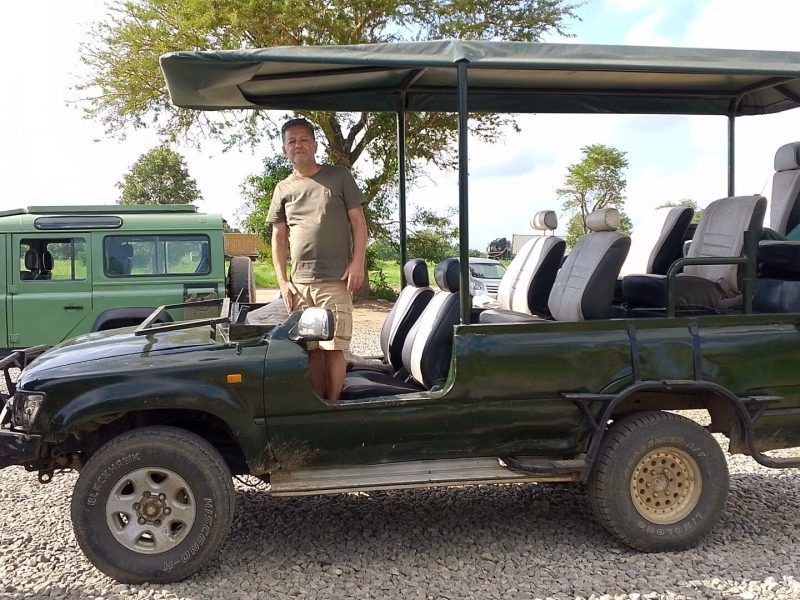
Burigi-Chato National Park is roughly 150 kilometres from Mwanza, a drive of three to five hours depending on the route, the road surface and the time of year. Most visitors cover it in a hired 4×4 with a driver arranged in Mwanza, since there is no direct public service. Mwanza is Tanzania’s largest city on the Lake Victoria shore and the main gateway airport for the northwestern parks, including Burigi-Chato in the Kagera and Geita regions.
The three-hour figure and the five-hour figure are both honest. Which one you get depends mostly on the season.
The Mwanza to Burigi-Chato Safari Distance in Practical Terms
A hundred and fifty kilometres sounds like two hours. It is not, and knowing why matters for planning a Burigi-Chato safari out of Mwanza.
Part of the route is tarmac and part is not. The unsurfaced sections closer to the park slow you considerably, and they degrade in the rains. You also pass through a string of rural settlements where speed drops for people, livestock and speed bumps, and the road is shared with heavy freight moving around the lake.
Then there is the gate. Reaching the park boundary is not the same as reaching where you are going. Chato town sits about 40 kilometres from the Katete Gate on the eastern side, and once inside, driving across to the Lake Burigi valley in the western sector takes most of a further day.
When an operator quotes you three hours from Mwanza, ask three hours to what. To the gate is a different answer from to the Nkonje ranger post beside Lake Burigi, and the gap between those two answers can be six hours.
What the Drive From Mwanza Is Like on a Road Safari
The route runs west and northwest from the city, following the southern arc of Lake Victoria before turning inland.
You leave Mwanza through its granite country. Balanced boulders and inselbergs are the signature terrain of this shoreline, and Bismarck Rock off the city waterfront is the best known example. The kopjes continue for some distance out of town and are genuinely worth looking at rather than sleeping through.
After that it is farmland and settlements: cassava, maize, banana, and roadside markets. Fishing villages appear where the road runs near the water. Traffic thins as you go west.
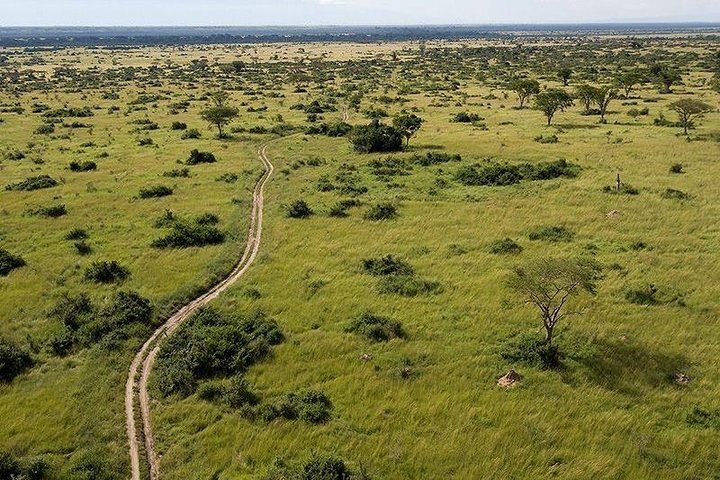
The final stretch toward the park is the slow part. Surfaces deteriorate, the country opens out, and you start seeing the wooded ridge terrain that fills the park itself.
Timing the Drive by Safari Season: Three Hours or Five
The spread in these estimates is not vagueness. It reflects genuinely different conditions.
June to September, dry: Three to four hours is realistic. Unsurfaced sections are firm, and the shorter end of the estimate is achievable if you leave early and do not stop.
October to December: Four to five hours. The lighter rainfall peak softens the gravel sections, and storms can hold you up for an hour at a time.
January to February: Three to four and a half hours. The drier interval between peaks usually holds up well.
March to May: Five hours and up, with real uncertainty. The heavier rains are when this drive becomes unpredictable rather than merely slow, and it is the window where flying starts to make sense.
Park driving hours run from six in the morning to six in the evening. Work backwards from that when you plan your departure, and leave yourself a buffer rather than aiming to arrive at the gate at five fifty.
Can You Do Burigi-Chato as a Day Trip From Mwanza?
Technically yes. In practice, no, and it is worth being blunt about it.
A round trip of six to ten hours of driving leaves you a few hours inside a park that covers 4,707 square kilometres. You would reach the eastern sector near the Katete Gate, drive a short circuit, and turn around. You would not see Lake Burigi, you would not do a boat safari, and you would not be in the park at either of the two hours when wildlife is actually moving.
The park’s day-trip permit exists and is valid for twelve daylight hours with multiple entries. It suits people already staying in Chato, not people driving out from Mwanza.
Two nights is the realistic minimum for a trip from Mwanza. Three is better if you want to reach the lake.
The distance from Mwanza is not the problem. The distance from the gate to anything worth seeing is the problem, and it is the part nobody quotes you.
How Mwanza Compares With Bukoba and Chato as a Safari Base
Mwanza is the default starting point because of its airport and its vehicle hire, not because it is close.
Mwanza, around 150km, three to five hours: The biggest airport in the region, the widest choice of operators and vehicles, and the natural hub for a wider Lake Zone route taking in Serengeti‘s western corridor, Saanane Island and Rubondo.
Bukoba, two to three hours: Noticeably closer, on the western lake shore, with scheduled flights and a lake ferry connection. Better choice of hotels than Chato and a shorter run in.
Chato, around 40km to the Katete Gate: The closest town by a wide margin, on the lake shore in Geita Region, with an airport taking domestic flights. Accommodation is basic guesthouses rather than hotels.
Biharamulo: Inland to the south with its own airstrip, close to the southern sector, and usually cited as the park’s nearest town of any size.
If your only goal is the park, Bukoba or Chato beat Mwanza on every measure except flight availability. If you are building a wider circuit, Mwanza wins, drive and all.
Flying From Mwanza for a Fly-In Safari Instead of Driving
Air removes the drive but adds cost, and the sums change depending on which airstrip you want.
Scheduled domestic flights connect Mwanza with Chato, which still leaves you about 40 kilometres to the Katete Gate by road. That is a real saving over the full drive but not a transformation.
The transformation is a private charter to the airstrip near the Nkonje ranger post beside Lake Burigi. That drops you in the western sector directly, next to the boat activities, the papyrus inlets and the best of the park’s water-based game viewing. It removes both the Mwanza drive and the long internal crossing, saving the better part of a day at each end.
Charters can also reach the Biharamulo airstrip for the southern ground. Landing fees are payable per aircraft on top of park charges, and light aircraft usually cap baggage at around 15 kilograms in soft bags.
What Else Is Within Reach of Mwanza on the Same Trip
Reading the Mwanza distance properly means seeing what else sits at similar range, because Burigi-Chato rarely justifies the drive on its own.
Rubondo Island National Park lies out in the southwest corner of Lake Victoria, reachable by air in around an hour from Mwanza or by road and boat via the lakeside villages. It is the largest island national park in Africa, with chimpanzee trekking, sitatunga and strong birding.
The western corridor of Serengeti National Park is closer than Burigi-Chato, with the Ndabaka Gate roughly 145 kilometres from the city on a three to four hour drive. Saanane Island National Park sits in the lake within sight of Mwanza and is Tanzania’s smallest national park, reached by a short boat crossing.
Ibanda-Kyerwa and Rumanyika-Karagwe National Parks sit further north along the Kagera corridor and pair naturally with Burigi-Chato on the same westward run.
Practical Preparation for the Mwanza Safari Transfer
A few things are worth sorting before you leave the city rather than after.
Fuel is the first. Fill up in Mwanza and top up again in Chato, Biharamulo or Bukoba, because there is no fuel inside the park. Cash is the second, since ATMs and reliable mobile money agents are in the towns, not on the road.
Park fees are the third and the one that most often causes trouble. TANAPA charges go through the government electronic payment gateway, paid online through the reservation system, at a bank by card, or by mobile money. Cash at the gate will not work, and gate connectivity is not something to rely on.
Carry your own drinking water and food for the road. Take a high-clearance 4×4 rather than a saloon, in every season.
Frequently Asked Questions About the Mwanza Safari Distance
What does a transfer from Mwanza cost?
Vehicle hire with a driver is the main expense and is charged per day whether you are moving or not, which is why a two-day trip from Mwanza typically lands somewhere between US$400 and US$900 per person depending on group size. Park charges on top are comparatively small: the conservation fee is currently US$30 per person per day for non-East African adults and US$10 for children aged five to fifteen, with US$15 and US$5 for expatriates and residents and TZS 5,000 and TZS 2,000 for East African Community citizens. Vehicle entry starts at TZS 20,000 per day for a Tanzanian registered vehicle up to 2,000 kilograms. Add 18 percent VAT to all TANAPA figures. Splitting a vehicle across four people rather than two changes the per-head cost more than any other decision.
How much does flying from Mwanza cost instead?
Scheduled flights to Chato are the cheaper air option and still leave a 40 kilometre road transfer. A private charter to the Nkonje airstrip beside Lake Burigi costs considerably more but removes both the road drive and the long internal crossing. Landing fees are payable per aircraft on top: currently US$50 for a private foreign aircraft up to four seats and US$120 commercial, rising with seat count, with much lower rates in shillings for locally registered planes. There is also an airstrip charge of around US$10 per person for non-East African visitors landing in a park but sleeping outside it.
Is it 150 kilometres or more?
Around 150 kilometres is the figure most consistently quoted for Mwanza to the park, though you will see slightly different numbers depending on which gate and which route is being measured. Some sources describing the drive give four to five hours rather than three to four, which reflects real variation in road conditions rather than disagreement about the distance. Treat 150 kilometres and three to five hours as the working range.
Can I do a day trip from Mwanza?
Not usefully. Six to ten hours of round-trip driving leaves you a few hours in a 4,707 square kilometre park, arriving and leaving outside the dawn and dusk windows when wildlife is actually active. You would see the eastern sector near the Katete Gate and nothing else. A day-trip permit exists, valid for twelve daylight hours with multiple entries, but it suits visitors already staying in Chato. Two nights is the realistic minimum from Mwanza.
Is the road from Mwanza tarmac?
Partly. Sections of the main route are surfaced and sections are gravel or unsurfaced, with the roughest stretches closer to the park. This is why a high-clearance 4×4 matters even before you reach the gate, and why drive times stretch so much in the March to May rains. In the dry season the road is manageable throughout, though still not fast.
Which is closer to the park, Mwanza or Bukoba?
Bukoba, at two to three hours against Mwanza’s three to five. Bukoba also has scheduled flights and a lake ferry connection, plus a better range of accommodation than Chato. Mwanza remains the more common starting point because it has the region’s main airport and the widest choice of tour operators and vehicles, and because it anchors a wider circuit including the western Serengeti and Rubondo Island.
How long does it take to cross the park once inside?
Most of a day from the Chato side to the Lake Burigi valley. The park is very large and its internal tracks follow ridge crests or valley floors rather than crossing freely between drainage systems, so map distances understate travel time badly. Plan to work one sector properly rather than trying to see the whole park from a single base, and choose your entry gate accordingly.
Booking Your Burigi-Chato Trip
The safari companies and tour operators listed on this website put trips like this together for a living and know which camps, guides and routes actually deliver. We are an independent guide to Burigi-Chato; we do not book or sell tours ourselves.
When you are ready, arrange your safari, tour or holiday with one of the recognised operators listed here. Tell them your dates and what matters most, and a real person, not a form, will handle the itinerary, park bookings and logistics for you.