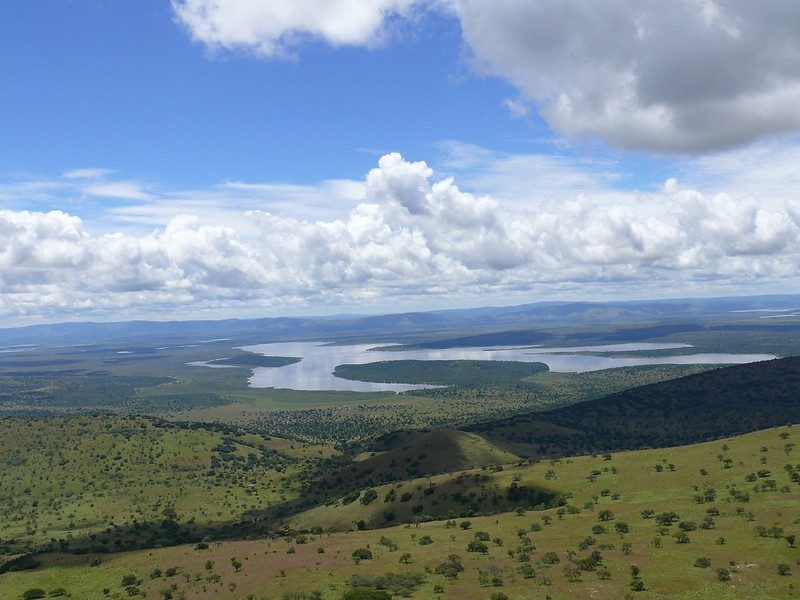
You can see sitatunga antelopes in Burigi-Chato along the swampy inlets and bays of Lake Burigi, in the papyrus margins reachable by boat from the Nkonje ranger post, and in the connected swamps of the Kagera drainage on the park’s western side. Trips are arranged through the park and run at first light. Burigi-Chato covers 4,707 square kilometres of northwestern Tanzania and is among the few protected areas in the country offering boat access to papyrus habitat.
The answer is narrower than the park is large. Almost none of those 4,707 square kilometres will produce a sitatunga.
The Short Answer on Where to Look on a Sitatunga Safari
Every productive sitatunga watching location in this park has three things in common, and if a spot lacks any of them you can rule it out.
Permanent standing water is the first. Sitatunga do not use seasonal pans or floodplain that dries out. Dense emergent vegetation growing out of that water is the second, which in this system means papyrus above all, with reed and sedge at the margins. An undisturbed edge between the two is the third, because that margin is where they actually feed.
Lake Burigi provides all three along its side arms. The main body of the lake, open water with clean shorelines, does not. Neither does the wooded savannah that covers most of the park, nor the ridge country, nor the drier floodplains that empty out between rains.
When a guide offers to look for sitatunga, ask which bay. If the answer is vague, you are being taken for a boat ride rather than to a known feeding margin. The people who find these animals know the specific inlets by name.
Lake Burigi’s Swampy Inlets: The Main Sitatunga Areas
Lake Burigi runs roughly 30 kilometres long and about 4 kilometres wide along a valley floor, with a scatter of islands and a great many inlets and bays branching off the main body. Park literature describes some of these side arms as swampy and identifies them as home to the rare sitatunga.
Those are the target. The lake’s length means there are a considerable number of them, and they are not all equal. Productivity depends on how extensive the papyrus is, how undisturbed the bay stays, and whether fishing activity reaches into it.
Working them takes time. From a boat you move along the reed line slowly, scanning with binoculars for movement or for the shape of a head above the vegetation rather than a whole animal in the open. A sighting is often a few seconds of head and shoulders, not a clear view of a standing antelope.
The narrower, more enclosed bays tend to outperform the broad open ones. Cover matters to these animals more than space does.
Nkonje Ranger Post as a Base for Sitatunga Watching Trips
Nkonje is the practical answer to where you should sleep if sitatunga are your reason for coming.
The ranger post sits beside Lake Burigi in the western sector of the park and offers bandas and a tented camp with basic amenities. There is an airstrip alongside it, which private charters can use, and public and special campsites are located near the shore.
Being there overnight is what makes a first-light boat departure possible at all. The alternative is basing in Chato, Biharamulo or Kayanga and driving in each morning, which puts you on the water hours after the productive window has closed. Driving from the Chato side across to the Lake Burigi valley takes most of a day in its own right.
Facilities are minimal. Bring your own drinking water and expect no mains power.
Sleeping at the lake rather than in town is the single decision that most changes your odds. Everything else is refinement.
Boat Safari Routes Along the Papyrus Margins
The boat safari is the main tool for reaching sitatunga habitat, and TANAPA charges a specific boating safari fee for Burigi-Chato alongside a handful of other water-based parks.
Motorised boats launch from near the ranger post and give you range, which matters on a lake this long. A single outing can take in several inlets, and the ability to move on when a bay proves empty is worth a great deal.
The technique is to enter a bay quietly, cut power well before the reed line, and drift or paddle the last stretch. Engine noise pushes sitatunga back into cover long before you arrive. Guides who understand this get sightings. Guides who motor straight to the papyrus edge do not.
You will see a great deal else on the way. Hippo pods, large Nile crocodiles basking on mud banks, African fish eagles at high density along the shoreline, saddle-billed stork working the shallows, and elephant, buffalo and waterbuck coming down to drink in the dry months.
Canoe Trips Into the Narrower Bays
Canoeing is offered separately from motorised trips and is capped at a maximum of three hours per session in this park, under the same rule that applies at Mahale, Rumanyika-Karagwe and Rubondo Island. The fee is lower than the boating safari charge.
For sitatunga, a paddle beats an outboard. Silence along a papyrus margin is worth more than the distance a motor covers, and a canoe lets you hold position at the edge of a bay without pushing the animals back. It also gets you into narrower channels that a boat cannot enter.
The tradeoff is range. Three hours of paddling covers a small fraction of a 30 kilometre lake, so you need a guide who will put you in the right bay from the start rather than exploring.
Guides route around hippo pods and you should let them without argument. A canoe and a hippo are a bad combination, no matter how still the water looks.
Kagera Drainage Swamps on the Western Side
Lake Burigi is not the only wetland in this park. The Kagera swamps extend along the western boundary toward the Rwandan border, and the Kagera River itself runs along that side.
Sitatunga occur through this wider system wherever papyrus is extensive and undisturbed. The Kimisi sector, in the north nearest the Rwandan border, sits within this drainage. Access is harder than at Lake Burigi, with fewer tracks and no boat infrastructure comparable to the ranger post facilities.
For most visitors this remains theoretical rather than practical. If you are on a mobile camping trip with an operator running special campsites, it becomes an option worth raising. On a standard two or three night visit, stay on Lake Burigi.
Conservation assessments of this area have recommended bringing a larger share of Lake Burigi and its lakeside swamps under protection, which tells you something about where the habitat pressure sits.
What Time of Day to Be in Position for Sitatunga Watching
Location is half the answer. Timing is the other half, and it is the part people get wrong.
Sitatunga feed at the papyrus and reed margins around dawn and dusk, then withdraw into the beds through the day. A mid-morning boat trip to the best bay in the park will show you nothing, while a first-light trip to a mediocre bay may well deliver.
Be on the water before sunrise, in position at the margin, engine off. Late afternoon into dusk is the second window and works too, with the added benefit that hippo start moving out to graze at the same time.
Plan two or three separate early sessions across a stay rather than one long outing. Their activity is tied to the light, not to how many hours you accumulate.
How to Arrange a Sitatunga Watching Trip With the Park
Boat capacity here is limited and the park’s visitor infrastructure is young, so this needs booking rather than turning up.
Arrange boats and canoes through the park, ideally in advance through your operator or via the TANAPA reservation system. A park guide is charged per group per day rather than per person, which makes it cheap across four people and is the single most useful thing you can buy here.
Payment matters too. TANAPA charges go through the government electronic payment gateway, made online, at a bank by card, or by mobile money. Cash at the gate will not work, and gate connectivity is not reliable enough to sort out on arrival.
Sightings are not guaranteed and no operator should promise one. A guarantee is a warning sign about the operator rather than information about the park.
Where Else in Tanzania to See Sitatunga on Safari
Knowing the alternatives helps you judge whether Burigi-Chato is the right choice.
Rubondo Island National Park: Out in the southwest corner of Lake Victoria, around 240 square kilometres, with sitatunga alongside chimpanzee trekking, elephant, giraffe and strong birding. Better established, with a proper camp, and often easier to reach by air from Mwanza.
Rumanyika-Karagwe National Park: North along the Kagera corridor, gazetted in the same round as Burigi-Chato, in the same fee band and with the same boating and canoeing charges. Very lightly visited.
The Moyowosi and Kigosi wetlands: A vast swamp system to the south holding sitatunga in extensive papyrus. Remote, expensive to reach, and set up for a different kind of trip entirely.
Akagera National Park, Rwanda: Across the border, protecting the opposite bank of the same Kagera drainage, with similar papyrus habitat and better developed tourism infrastructure.
Burigi-Chato and Rubondo pair naturally on one Lake Victoria trip and between them give you two very different shots at the same species.
Best Season for Sitatunga Watching in the Park
June to September: The strongest window. Lower water levels pull the swamp margins into a narrower, better-defined band, which concentrates the animals rather than spreading them through widely flooded vegetation. Settled dawn boat conditions.
October to December: Water rises with the lighter rainfall peak and sitatunga disperse through a wider area of flooded reed. Harder to pin down, though birding along the same margins is at its best.
January to February: A drier gap between peaks. Workable, quiet, and a reasonable second choice.
March to May: Heaviest rain and highest water, with the animals at their most scattered. Boats still run, but reaching launch points on unsurfaced tracks becomes the limiting factor.
July through September, at first light, is the answer if you have a free choice.
Getting to the Sitatunga Areas for Your Safari
The western sector where the swampy inlets sit is the far side of the park from the Katete Gate, and this matters for how you arrive.
By road, Bukoba is the nearest gateway town at two to three hours, with Mwanza around 150 kilometres out on a three to five hour drive and Chato about 40 kilometres from the eastern gate. Any of these leaves you a long internal drive to reach Lake Burigi.
By air, a private charter to the airstrip near the Nkonje ranger post drops you directly at the lake and removes both the road transfer and the internal crossing. For a sitatunga-focused trip, this is the routing that buys you the most productive mornings per day of holiday. Chato and Bukoba receive scheduled domestic flights with a road transfer onward, and the Biharamulo airstrip serves the southern ground.
A 4×4 is necessary for any road option in every season.
Frequently Asked Questions About Sitatunga in Burigi-Chato
What does a sitatunga watching trip cost?
The park conservation fee is currently US$30 per person per day for non-East African adults aged sixteen and above and US$10 for children aged five to fifteen, with US$15 and US$5 for expatriates and Tanzanian residents and TZS 5,000 and TZS 2,000 for East African Community citizens. On top of that, the boating safari fee is US$20 per person and canoeing is US$10 per person for up to three hours. A park guide is US$20 per group per day. All TANAPA charges carry 18 percent VAT.
Where exactly should I ask my guide to take me?
The swampy inlets and bays branching off the main body of Lake Burigi, on the western side of the park, launching from near the Nkonje ranger post. Narrower, more enclosed bays with extensive papyrus and little fishing activity outperform the broad open ones. Ask your guide which specific bays have produced sightings recently, because conditions and disturbance change and last season’s best inlet may not be this season’s.
Can I see sitatunga from a vehicle rather than a boat?
Very unlikely. These animals live in papyrus growing out of standing water, which no vehicle track reaches, and they feed at the margins at hours when you would need to already be in position. Walking into papyrus is not possible either, since it grows on floating mats that will not carry a person’s weight, over water holding hippo and crocodile. A boat or canoe is the only realistic method.
How many mornings should I allow?
Two or three, which means a stay of at least two nights at or near the lake. One attempt is a coin toss on an animal that is shy, well camouflaged and only active in a narrow window. Three early sessions in the dry season with a guide who knows the bays gives you a reasonable chance without any promise attached. If you can only manage one morning, go anyway, but set your expectations accordingly.
Where should I stay to reach the swamps early?
The Nkonje ranger post area beside Lake Burigi, which has bandas and a tented camp, or one of the public and special campsites near the shore. TANAPA rest house, cottages and park-provided tents at Burigi-Chato currently run at around US$35 per adult per night for cottages and rest house and US$30 for park tents, with public campsites at US$30 per adult and special campsites at US$50. Staying in Chato or Bukoba and driving in each morning puts you on the water too late.
Is Rubondo Island better for sitatunga than Burigi-Chato?
Easier, rather than better. Rubondo has an established camp, regular flights from Mwanza taking around an hour, and sitatunga alongside chimpanzee trekking and a bird list running past four hundred species. Burigi-Chato is cheaper, emptier and offers more extensive papyrus, at the cost of basic facilities and harder access. Many travellers do both on one Lake Victoria trip, which is the strongest option if the species matters to you.
What should I bring for an early boat trip?
Binoculars with good low-light performance matter more than anything else, since you are scanning dim reed lines for partial glimpses. A fleece and a windproof layer, because dawn on open water here is genuinely cold whatever the daytime forecast says. A fast telephoto lens with high ISO tolerance and a dry bag. Strong insect repellent for the swamp margins, and your own drinking water, since there is none available inside the park.
Booking Your Burigi-Chato Trip
The safari companies and tour operators listed on this website put trips like this together for a living and know which camps, guides and routes actually deliver. We are an independent guide to Burigi-Chato; we do not book or sell tours ourselves.
When you are ready, arrange your safari, tour or holiday with one of the recognised operators listed here. Tell them your dates and what matters most, and a real person, not a form, will handle the itinerary, park bookings and logistics for you.